TopRank Marketing and Sprinklr Win a Prestigious 2024 Content Marketing Award

New York, NY USA — The Content Marketing Institute (CMI) just announced TopRank Marketing and Sprinklr won a 2024 Content Marketing Award for “Across the Socialverse 2023: B2B Social Influence.” The Content Marketing Awards, presented each year by CMI, is the largest and longest-running international content marketing awards program in the world for content creation, distribution, and innovation.

The Content Marketing Awards recognize the best content marketing projects, agencies, and marketers in the industry each year. This year’s panel of all-star judges reviewed nearly 1,000 entries to determine the best of the best in content marketing excellence.

The 60 categories recognize all aspects of content marketing, including the best in strategy, automation, research, social media, video, editorial, illustration, design and much more, across many different industries from healthcare to manufacturing, from B2B to B2C. 

“It’s been another great year of content marketing excellence,” shares Stephanie Stahl, managing director, Content Marketing Institute. “The winning marketers and brands prove that content — strategic, compelling, informational, and inspiring content — is at the heart of any great marketing program. These winners showcase some of the most innovative and successful content and experiences in the marketing industry. We are honored to award their hard work and share their amazing projects with our content marketing community.”

The Socialverse campaign, developed by TopRankMarketing and Sprinklr, took shape as a documentary-style masterclass hosted by social media thought leaders, helping Sprinklr expand to new audiences and build resonant awareness around their powerful new AI-integrated Self Serve Plan offering. 

“It’s an especially big honor to be recognized among a field of finalists in this category that featured several very impressive and high-scale B2C influencer campaigns,” says TopRank Marketing CEO Donna Robinson. “This really is a sign of how far B2B influencer marketing has come, and where it’s going.”

As winners of Best Use of Influencer Marketing, TopRank Marketing – Sprinklr are now in consideration for Project of the Year. Finalists and winners for that category — along with Branded Campaigns of the Year, Agencies of the Year, and Content Marketers of the Year — will be announced in September and winners will be celebrated at Content Marketing World, October 21-23 in San Diego, California. 

About TopRank Marketing

Founded more than 20 years ago, Minnesota-based agency TopRank Marketing has long been a leading force in the B2B influencer marketing practice, producing the annual B2B Influencer Marketing Report and partnering with big brands around the globe to plan and execute winning strategies.

About Content Marketing Institute

Content Marketing Institute (CMI) exists to do one thing: advance the practice of content marketing through online education and in-person and digital events. We create and curate content experiences that teach marketers and creators from enterprise brands, small businesses, and agencies how to attract and retain customers through compelling, multichannel storytelling. Global brands turn to CMI for strategic consultation, training, and research. Organizations from around the world send teams to Content Marketing World, the largest content marketing-focused event, the Marketing Analytics & Data Science (MADS) conference and CMI virtual events, including ContentTECH Summit. Our community of 215,000+ content marketers shares camaraderie and conversation. CMI is organized by Informa Connect. To learn more, visit https://ift.tt/PgXBaK1.

The post TopRank Marketing and Sprinklr Win a Prestigious 2024 Content Marketing Award appeared first on TopRank® Marketing.

Read More »

Researching Keywords for Your SEO Strategy, Step by Step

Successfully ranking for the keywords you’re targeting won’t make much of an impact on your business if those keywords are not relevant to your audience and their buying journey. In fact, many companies end up wasting a lot of time and resources in this pursuit. That’s why a smart, thoughtful and data-driven keyword strategy is paramount to an effective SEO strategy.

Fortunately, you have everything you need to start conducting keyword research and setting your strategic direction now.

How to research keywords for your B2B SEO strategy

By following this step-by-step process, you can start figuring out what your audience wants to find, how they’re looking for it, and how you show up for them in the search results.

Check your current rankings

Before you start researching keywords, it’s always wise to run an SEO audit of your current rankings as step one. This can provide a baseline of what your website is showing up, which can help you understand where search engines view your domain as authoritative. 

Checking your website’s SEO rankings is fairly straightforward, and there is a wide variety of both free and paid online tools you can use to do it. 

Conduct a competitive analysis

An SEO competitor analysis is a review of how your competitors are showing up in search. This concerns not only business competitors (i.e. companies competing for your customers) but also SERP competitors (i.e. companies competing for your target keywords), which are not always the same. 

This process can tell you a lot about how competitors are approaching their keyword strategies – and how you can differentiate yours or overtake key rankings.

Look for opportunities using a gap analysis

As you’re analyzing competitors, keep an eye out for any opportunities they’ve missed – or “gaps” in their SEO footprint. These include topics that they aren’t showing up for, but that customers in your solution category are searching for.

An SEO gap analysis can be a great place to start your search, surfacing keywords your competition may have overlooked entirely. Many online SEO tools and expert partners can help you quickly surface gaps in your competition’s keyword strategy. At TopRank, we develop keyword glossaries that list competitor rankings for each keyword alongside your own rankings to easily see where you can fill in the blanks for your audience and build share of search.

Bonus: Create a topical map 

In modern SEO, it’s very important to demonstrate topical authority by covering priority subjects in depth and at length. You want search engines like Google to recognize your domain’s expertise and focus on a topical area by covering as many facets of it as possible, creating and cross-linking content for the core keyword as well as relevant longtail offshoots and variations. (This is often referred to as a hub-and-spoke model.)

A topical map can be a fantastic tool for this purpose, helping you clearly map out different keywords that are tied together by user intent. Our agency builds topical maps for clients as part of our SEO service offerings and they are amazingly useful for content planning.

Prioritize relevance and intent over volume

When it comes to finding keywords worth pursuing, you should always consider relevance and intent more important than volume — especially in B2B marketing. As any savvy practitioner knows, bringing a dozen of the right people to your site is much more valuable than 100 of the wrong people.

Keywords with relatively low monthly search volume can be valuable if the people looking for them have the right relevance and intent. As you search for SEO keywords, try to determine how the most educated, high-intent users are searching for products and services like yours. Chances are, you’ll determine that they’re using lower volume search terms to try to hone in on what they’re looking for more specifically. 

The most effective SEO strategies focus on a combination of high, medium, and low volume keywords of high relevance and match their content to intent accordingly, filtering users from higher-volume keywords to more specific product-related pages.

Balance volume and achievability 

Along with the average search volume that a keyword drives, SEO tools will also highlight the keyword difficulty. This is often expressed as a percentage, with 0% being the easiest and 100% being the hardest. Keyword difficulty is essentially a measure of how firmly entrenched the current top results are in the SERP for a given keyword. As keyword difficulty increases, you’ll need better content and more referring domains to compete with other results.

Keywords with high volume and low difficulty are often the “low-hanging fruit” worth prioritizing, but chances are you won’t find enough of those keywords to build out your full strategy. 

After that, you’ll have to pick and choose your battles by evaluating what’s valuable vs. what’s achievable. Striking the right balance will mean targeting a healthy combination of high-intent, low volume keywords with low or reasonable difficulty and higher volume keywords with achievable difficulty. 

Report, rinse, repeat

Effective SEO strategy is never “finished.” As you pursue the keywords you’ve surfaced, report on your ranking progress on a regular basis. Evaluate how effective your approach is to optimize your strategy over time, and continuously look for new keywords you can start targeting to round out your strategy and build your domain authority. 

SEO keyword strategy template

Consult the following checklist for each keyword you’re considering adding to your strategy. The more boxes you can check off for the keyword in question, the better an opportunity it represents. 

  • Ranking for this keyword would improve your brand’s visibility and/or drive the right audience traffic to your site
  • This keyword is directly relevant to your brand’s topical pillars
  • When people search for this keyword, they are looking for information you have the expertise and authority to provide
  • Users who search for this keyword are at some stage of your marketing funnel
  • Your direct competitors are not ranking in the top 10 positions for this keyword OR you feel confident that your content could outrank theirs
  • This keyword has enough monthly search volume OR the right search intent to drive quality traffic to your site
  • This keyword has low enough keyword difficulty that a site with your level of authority could rank for it 
  • You already have or could create compelling content that provides what users are looking for when they search this keyword

In all likelihood, most of the keywords you find will not check each of these boxes. That doesn’t necessarily mean they’re not worth pursuing. Use this SEO keyword strategy template to inform your larger SEO strategy and help you determine which keywords to prioritize first, not as the sole arbiter of whether pursuing a keyword could be useful.

Despite all the advanced tools and resources you have to help you, researching keywords for an SEO strategy remains as much art as science. Finding the right keywords to pursue is as much about understanding your audience and your industry as it is practicing good SEO — which is exactly why modern SEO advice like this is all about helping you do both.

For more help finding and pursuing the right keywords, check out our full guide on Why You Need a Keyword Strategy and How to Create One


The post Researching Keywords for Your SEO Strategy, Step by Step appeared first on TopRank® Marketing.

Read More »

Best B2B Marketing Content for Each Funnel Stage

B2B content marketing is no longer restricted to white papers and case studies. It can’t be. B2B buyers — otherwise known as humans like the rest of us — demand more variety, more creativity, and more relevance than the old reliable formats can offer.

Your buyers are hungry for great content. Don’t serve them white-bread-and-mayo sandwiches. Create a loaded buffet of exciting, relevant, helpful content for their entire journey.

Here are the best content types for each stage of the marketing funnel.

Awareness stage: Appetizers

In the first stage, the buyer might not realize they’re even on a journey. You can’t jump right into selling. You have to whet their appetite before they attend your content feast.

Stick with eye-catching, creative but practical content at this stage, using formats like:

  • Infographics with meaningful statistics
  • Videos that highlight your brand’s values & expertise
  • Thought leadership blogs and podcasts
  • Social media posts building and engaging with a community

Remember, this stage is about possibility. You want to show people there’s a better way of doing something, introduce your brand as an empathetic expert, and make them hungry to learn more.

Consideration stage: Salad and garlic bread

Now your buyer knows that they have a solvable problem. Thanks to your excellent thought leadership appetizers, they also know that your brand is a source of valuable experience and advice. 

Now you can offer them some fresh textures and flavors to keep them engaged and get them ready for the main course.

Keep up your drumbeat of useful, practical content, but you can stir in a few more types:

  • Ebooks that showcase original research and influencer insights
  • Interactive content to provide novelty, creativity and value
  • Webinars that aim to help buyers be better at their jobs
  • Customer stories that focus on customer success, not just your brand’s role in it

This stage is about proof — proof that your brand knows its stuff, is here to help, and has helped others in the past.

Decision stage: Main course

Your buyer is seated at your table with their napkin tucked into their collar, ready for an entree. Now is the time to bring your solution to the forefront. At this stage, you can be overt about what makes your company the best one to solve this particular problem. 

Make your lower funnel content thrilling and filling with these content types:

  • Case studies that show how, specifically, your solution helped solve your clients’ problems (these can be in article, eBook, blog or video format)
  • Demo videos that make it clear how your solution works
  • Social proof like a compilation of customer reviews or a roundup of social media posts from satisfied customers
  • One-sheets that highlight features and pricing in an easy-to-share format

This stage is all about persuasion — equipping your audience with enough information to make a purchase decision.

Retention stage: dessert

Any B2B marketer worth the title knows that marketing doesn’t stop with a sale. Now it’s time to make sure your buyer is thoroughly satisfied and ready to recommend your brand to others. That means sprinkling in a little sweetness, some memorable experiences to leave a good taste in their mouth.

Offer up a decadent dessert with these content types:

  • Demos & webinars that aim to help existing customers get the most out of your solution
  • Community-building on social media and forums, to help customers get to know each other and become brand advocates
  • Customer stories that highlight how customers in their industry have used your solution, and which upgrades are the most useful

This stage is about passion. You want customers to feel passionate about your brand, full of positive experiences, and ready to write that 5-star review.

Create a culinary content experience

In the introduction, I referred to full-funnel content as a “buffet.” That word is important because it reminds us that a customer journey is:

  1. Self-directed
  2. Non-linear
  3. Unpredictably paced

If your potential buyer wants to load up on salad and breadsticks and then go straight to paying the check and having dessert, your content buffet will accommodate them. Full-funnel, varied content is a content growth strategy you can rely on.

Ready to upgrade your content from fast food to haute cuisine? We’re here to help.

The post Best B2B Marketing Content for Each Funnel Stage appeared first on TopRank® Marketing.

Read More »

How to Create Unique Content for Better SEO

Why does unique content matter?

Consider Janis Joplin.

On a technical level, Janis’ voice isn’t great. Her pitch is wobbly; her tone is nasal and gritty; her range is limited. There are hundreds of people waiting tables right now who can sing circles around her. Yet Janis is an enduring icon—because her voice is unique, not in spite of it. The moment she starts wailing, you would never mistake her for anybody else. She’s not a cookie-cutter karaoke star. She’s a bona fide original.

Uniqueness makes you stand out. That’s doubly true in the B2B content marketing world. It’s triply true now that AI-generated content is flooding search results with optimized but hollow content-by-volume.

Your brand’s unique personality, as expressed by your content team, can cut through the nonsense and earn attention. 

Here’s what makes content unique, how uniqueness helps SEO, and what you can do to get it. 

Three Ways Content Must Be Unique for SEO

We all know that content should be original, empathetic and valuable. These attributes are the price of entry—they’re the minimum. Unique content needs to also be:

Unique from AI-generated content

I had a moment of truth a few days ago. I had written an article based on a Chat-GPT outline and wanted to make sure I didn’t incorporate too much AI-ness. So I used an AI detector. 

The detector flagged my 100% original text as AI generated. 

In other words, I was writing like a bot. I quickly rewrote the paragraphs in question to make sure they conveyed the human behind the text. 

And now I’ve demonstrated what makes non-AI content unique: A human point of view. The previous couple of paragraphs are about something I experienced. AI doesn’t do that—it has no lived experience to draw from.

Keep your content unique from AI by:

  • Bringing a singular personal perspective
  • Using metaphor and analogy
  • Practicing empathy for your audience
  • Surfacing new ideas by drawing on past experience

AI can’t do any of these things reliably or well. Make sure your content won’t make anyone wonder if it was written by robots.

Unique from other brands’ content

If your content was stolen and published on a competitor’s site without your branding, would anyone be able to tell? Would your brand’s experience, insight, and personality shine through?

There are a few ways to make sure your content couldn’t come from anyone else, including your competitors: 

  • Tell unique brand stories. Talk about your customers, your years of service, your employees. Weave these brand stories into every piece of content.
  • Take strong stances on industry issues. Be opinionated and even passionate about the problems facing your industry and your proposed solutions.
  • Let personality shine through. The stiff, corporate, disembodied “B2B voice” is a thing of the past. Write as a person, for people.

Unique from your previous content

Most B2B brands have been pushing out content for years, if not decades. That means the very real danger of ‘too much of a good thing.’ If you have multiple pieces of content angling for each keyword you’re targeting, your site’s SEO potential is getting diluted.

For example, you might have a dozen similar thought leadership posts about sustainability. Each post is competing with content from other businesses, but each one is also competing against your other content. It’s hard for any one of your posts to rise in the search results against that much competition.

To avoid competing with your own content, it’s worth performing a thorough content audit to:

  • Identify thin or repetitive content
  • Determine which content can be refreshed and which should be redirected
  • Identify opportunities for creating new content

Quality is the new quantity

The gold rush for quantity content is over. It’s time for us B2B content marketers to get back to our roots: Creating high-quality, empathetic, meaningful content that inspires and moves people. Let’s aim to be Janis Joplin: Memorable, genuine, even rough around the edges, and completely unforgettable.

Ready to make your brand stand out from the crowd? We can help.

The post How to Create Unique Content for Better SEO appeared first on TopRank® Marketing.

Read More »

Which Factors Matter Most for Winning SEO Rankings?

The inner workings of the Google search algorithm have long been considered one of the great mysteries in digital marketing. 

Specific ranking factors, and how they are weighted, can be difficult to nail down due to the complexity, dynamism and sheer volume of attributes evaluated by search engines. Not to mention, Google and other companies tend to keep proprietary details close to the vest.

However, based on information that has been shared publicly, as well as some eye-opening document leaks, search marketers have been able to piece together a fairly complete and up-to-date picture of SEO ranking factors.

At TopRank Marketing, we make it our business to maintain a clear understanding of what matters most when it comes to ranking in SEO, and which aspects should be prioritized by brands aiming to win for competitive terms. Now, we’re making it your business as well.

SEO ranking factors according to Google

In their official resource center, Google has a page explaining how results are automatically generated, dividing the process of fetching results into five facets:

  1. Meaning: Google establishes the intent behind your query by leveraging language models that match your search terms to useful content.
  2. Relevance: Content is analyzed to assess whether it contains information that might be relevant to what the user is looking for.
  3. Quality: The engine prioritizes pages that seem most helpful, by identifying signals that help determine which content demonstrates expertise, authoritativeness and trustworthiness.
  4. Usability: As a secondary threshold, content that people will find more accessible – e.g. mobile responsiveness and fast page loads – can see a boost. 
  5. Context: Results are personalized for relevance based on information such as user location, past search history, and search settings.   
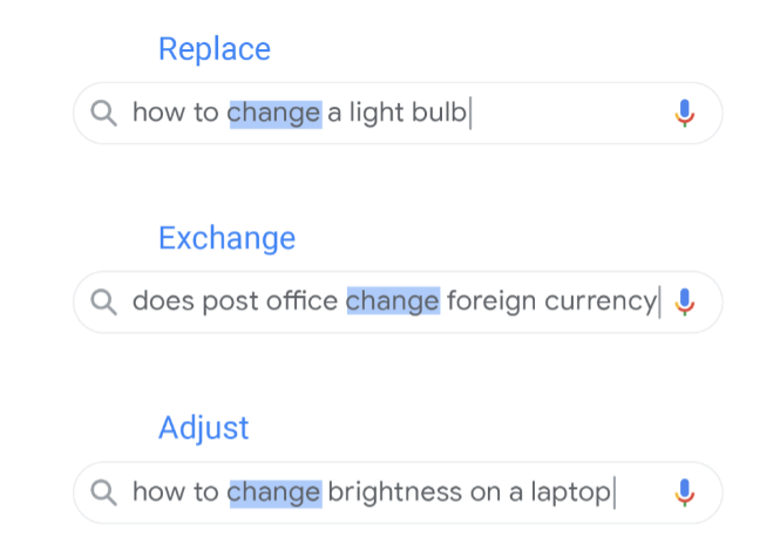
Google Search Intent

The screenshot above, via Google, illustrates how the search engine’s model recognizes and contextualizes intent behind various queries. Per the company, “This system took over five years to develop and significantly improves results in over 30% of searches across languages.”

Another important note from Google: “If you search for trending keywords, our systems understand that up-to-date information might be more useful than older pages. This means that when you’re searching for sports scores, company earnings or anything related that’s especially new, you’ll see the latest information.” We’ve seen this play out time and time again with client programs: pages that focus on fast-changing topics can lose rankings in a hurry when not updated regularly.

A deeper third-party look at SEO ranking factors

The above guidelines from Google are quite useful in creating content that’s built to rank. Understanding the search intent behind a keyword, and creating something of relevance and high quality to meet it, will be the primary path to gaining organic visibility. That’s no secret, although it’s easier said than done.

Within this guiding directive, there are plenty of smaller steps you can take to ensure content is optimized for search. Brian Dean of Backlinko compiled an exhaustive list of more than 200 ranking signals on Google, ranging from proven fixtures to “SEO nerd speculation.”

There are too many inclusions to cover here, and we recommend reviewing the full rundown, but here are the different categories of SEO ranking factors, and what they entail.

Domain factors

This includes things like the age, history and perceived legitimacy of your domain.

Page-level factors

These concern the composition, structure and performance of the web page itself. Here you’ll want to account for everything from using keywords in titles and headers to technical factors like page load speed.

Site-level factors

Google analyzes the broader website that a page belongs to when evaluating the content itself. A page can benefit or be penalized by the quality of the site’s reputation, architecture and usability. It can also receive a boost from strong E-E-A-T signals.

Backlink factors

An important part of your link-building strategy, backlinks are links from one website to another that can serve as endorsements for search visibility. Search algorithms consider not only the number of backlinks a page receives, but also the quality and diversity of those backlinks, and the authority of the sources.

User interaction

While robotic algorithms do plenty of behind-the-scenes work to organize search results, humans play a big role in influencing how the results are arranged, because Google leans strongly on user-driven signals such as organic click-through rate, dwell time, direct visits and beyond.

Special Google algorithm rules

Over the years, Google has rolled out a number of algorithm changes, often with specific purposes and implications. This includes, for example, highlighting featured snippets and applying higher quality standards to “YMYL” (Your Money Your Life) keywords.

Brand signals

Don’t underestimate the extent to which your brand’s online footprint can come into play as an SEO ranking factor. Having active company accounts on social media platforms like Facebook, X/Twitter and LinkedIn is believed to boost SEO visibility. Additionally, having your brand’s name searched frequently in combination with the keywords you want to own can be hugely advantageous.

On-site Webspam factors

Webspam, also known as “spamdexing,” refers to content that is designed to manipulate search rankings in ways that don’t serve the user. Google will punish pages and sites that it views as having low-quality content (e.g. AI-generated content farms), keyword-stuffing, hidden affiliate links, meta tag spamming and more.

Off-site Webspam factors

There are some external spam-focused factors you should also avoid being associated with. This often relates to inbound link patterns that Google views as shady (unnatural influx, low-quality sources, selling backlinks, etc.). 

Most important SEO ranking factors

Backlinko views these eight individual factors as the top ones to prioritize when creating or refreshing content, and they mostly line up with our agency’s experience. But remember, before you get to optimizing around these factors, it’s important to be sure you’re focusing on the right keywords to begin with.

  1. Quality Content
  2. Backlinks
  3. Technical SEO
  4. Keyword Optimization
  5. User Experience (UX)
  6. Schema Markup
  7. Social Signals
  8. Brand Signals

What to know about the Google ranking factors leak

It was big news within the SEO community when, in May of 2024, a massive internal Google document leak on GitHub provided unprecedented transparency into how Google’s ranking algorithm potentially operates. Many of the leaked insights served to reinforce the importance of search intent, uniqueness, and freshness of content, but there were also some surprises.

Among the big-picture takeaways from SEO legend Rand Fishkin, CEO of SparkToro, was that brand signals – despite ranking eighth on the above list – matter a lot more than previously thought. 

“If there was one universal piece of advice I had for marketers seeking to broadly improve their organic search rankings and traffic,” said Fishkin, “it would be: ‘Build a notable, popular, well-recognized brand in your space, outside of Google search.’”

How does AI affect search rankings?

It’s impossible to fully cover any search-related topic without discussing the role of AI. As you’re likely aware, Google has rolled out a generative search tool which provides AI-powered snapshots at the top of many results pages. This will have an effect on the searcher’s experience and the overall clicks to organic results. 

In terms of ranking factors, the most important thing to know: Google is continually growing more sophisticated in detecting and penalizing AI-generated content, as well as spammy tactics supported by the technology. 

While AI can be extremely powerful and beneficial for enhancing your marketing, brands should be very careful to avoid using it in ways that don’t ultimately lead to serving their audience unique, helpful, human content. 

Push your top content to the top of the search rankings

Developing content that ranks near the top of a search engine results page (SERP) is challenging, but crucial to driving organic traffic for key terms. Research has found that pages appearing in the #1 position generate double the click-through rate of position #2, and nearly 4x the CTR for position #3. Results at the bottom of page one (#10) drive just a 1.6% CTR on average compared to 39.8% for the top spot.

Aiming for that top rank requires a strategic approach, a commitment to developing strong authority in your domain, and a clear understanding of SEO ranking factors. 

Ready to win in the SERP? Learn more about building a powerful SEO strategy, or explore TopRank Marketing’s industry-leading SEO services.

The post Which Factors Matter Most for Winning SEO Rankings? appeared first on TopRank® Marketing.

Read More »

Don’t Build a B2B Go-To-Market Strategy Without These 7 Components

Q: Why did one little piggy’s business do much better than the others?

A: He had a good go-to-market strategy.

All jokes aside, a solid go-to-market (GTM) strategy can make the difference between a successful product launch and a misfire. If you’re not honing your strategy, you might as well stay home. (And have roast beef. Okay, that was the last one, promise).

Recent research shows that only 30% of marketers say their GTM strategy is “very effective” at driving revenue and achieving business objectives. If you’re in the other 70%, here’s what you need to know about GTM strategies for B2B marketers.  

What is a B2B go-to-market strategy?

A B2B go to market (GTM) strategy is a comprehensive plan that outlines how a company will launch a product or service — essentially how to introduce this new solution to the most valuable audience. A good GTM strategy will:

  • Identify a target market
  • Demonstrate how the solution meets customer needs
  • Define the unique value proposition compared to the competition.

The strategy should also include the sales and marketing tactics that will be used to attract and retain customers, as well as key performance indicators (KPIs) and the metrics to measure them. 

Ultimately, the goal is to coordinate every part of the business to work towards common goals, making the rollout efficient and as effective as possible. 

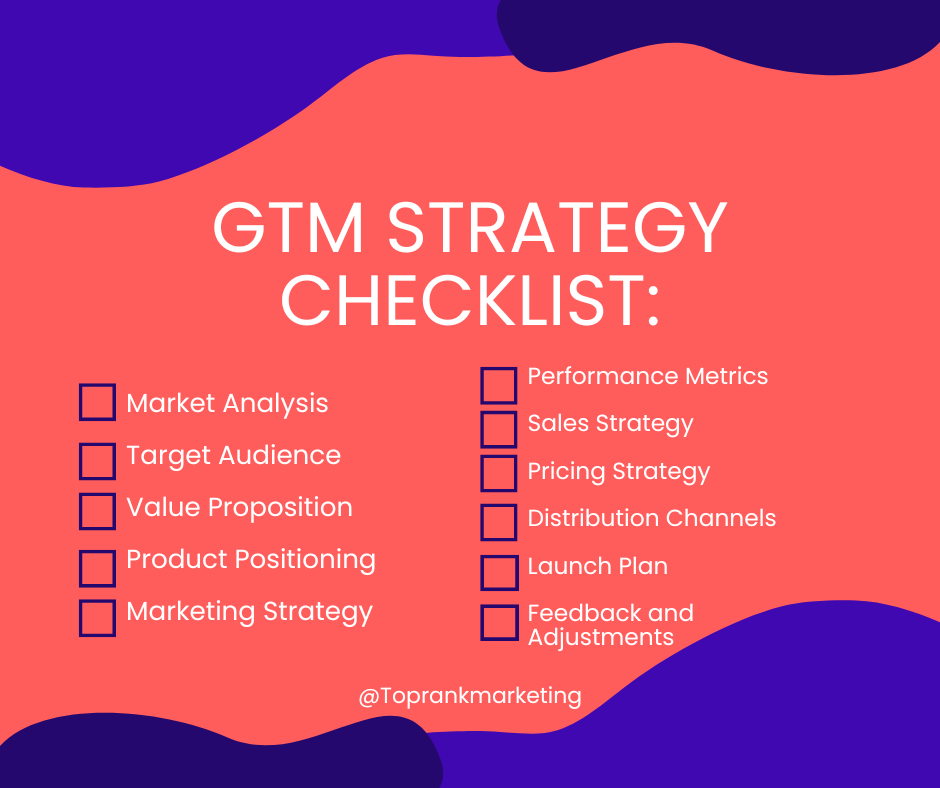
What should be included in a B2B go-to-market strategy

These key elements will help ensure your GTM strategy is comprehensive and thorough enough to be a valuable guide for the entire business.

1. Market research

A successful strategy starts with a thorough understanding of both your audience and current market conditions, including:

Audience analysis

It’s important to identify your target audience and segment by relevant demographic distinctions. You might include demographics like business size and industry for accounts, then narrow down to individuals within these businesses by role, seniority and job title. 

Collect your audience information through surveys, interviews and data analytics. 

Competitor analysis

What your competitors are doing – what’s working and what isn’t – is a key part of understanding the current market. Analyze competitors’ products, positioning, marketing and customer response. 

2. Value proposition

Why should people buy your solution instead of a competitor’s? Why should they buy your solution instead of taking no action at all? Your value proposition should clearly address these two questions by listing:

Customer pain points

Start by detailing the needs and challenges of your target audience. It’s a good idea to conduct customer interviews and surveys to understand their pain points on a fundamental level. 

Unique selling points (USPs)

Show how your solution addresses the specific needs and pain points you’ve uncovered. These selling points should be as specific, clear and concise as possible. They should demonstrate unique value — something your competitors don’t currently offer. 

3. Product positioning

Once you’ve established your value proposition, you need to translate it into messaging that makes sense for your audience and the market in general:

Market fit

Conduct thorough market validation to confirm there’s a need for your solution, and to see what adjustments you could make for an even better fit. It’s a good idea to get feedback from potential customers at this stage.

Brand messaging

Look to develop consistent messaging that communicates your solution’s value across channels. Your messaging should express your brand’s identity and clearly articulate the benefits and selling points of your product or service. Plan for a mix of content formats — blogs, case studies, videos — to reach and engage your audience. 

4. Marketing plan

All of your audience and solution research should culminate in a robust, thorough marketing 

plan. This plan should include:

Mapping the buyer’s journey

We know that B2B buyers don’t usually follow a linear course from awareness to purchase. But it’s good to define the stages of the journey so that you can make sure to market to each — even if buyers don’t encounter them in order.

Channels and tactics

Identify the most effective marketing channels for your audience, including the social media platforms they frequent, key terms to bid on for paid search, and where paid advertising is likely to reach them. Develop a coordinated strategy that uses these channels in harmony to maximize reach and engagement.

Content strategy

Focus on creating high-quality, relevant content that offers value to your potential customers before trying to make a sale. Content formats like infographics, videos, and webinars can help raise awareness. Whitepapers, ebooks and demos can help turn browsers into buyers

5. Metrics and KPIs

It’s important to have measurement baked into your GTM strategy. That way, you will be sure to collect the necessary data to match your measurement plan. 

Setting goals

Your goals should be directly connected to the health of the business. Use specific, measurable, achievable, relevant, and time-bound (SMART) goals. These goals might include market penetration rates, revenue targets, and customer acquisition costs.

Tracking performance

Plan how you will track these KPIs, including tools and systems you’ll need to gather data.  Use analytics platforms to monitor website traffic, engagement rates, conversion rates, and sales data. Regular analysis of these metrics will help you adjust your strategies as needed.

6. Launch plan

With your marketing strategies and metrics in place, you’re ready to plan the launch. A successful launch should include these three elements:

Pre-launch activities

In the time before launch, finalize your product testing to make sure it’s fully functional and meets customer expectations. Prepare your marketing materials, including website content and press releases, and select a date to launch that aligns with key events in your industry. 

Promotion strategy

Plan a series of announcements leading up to and following the launch to capture attention and maintain engagement. You can leverage your relationships with relevant influencers to help get the word out, in addition to your established marketing channels. 

Post-launch adjustments

It’s a good idea to implement mechanisms to collect customer feedback after the launch, and then make quick adjustments based on the product’s initial market reception. 

7. Refinement and optimization

Marketing is a journey of endless improvement, and that should be true of your GTM strategy, too. It’s important to have the ability to measure success, know what adjustments to make, and be able to make them quickly.

Collect feedback

Use customer surveys and social listening to get insights from prospects and early adopters. 

Make adjustments

Try for an iterative development process that prioritizes frequent, small adjustments based on feedback. It’s a good idea to schedule regular meetings with key stakeholders to assess the feedback and prioritize changes.

Boldly go to market with your strategy in place

Launching a new solution can feel like a gamble. But it doesn’t have to be—with research, preparation and coordination, you can put together a GTM strategy that tips the scales in your favor. 

Need help creating a robust GTM plan? Contact us today.

The post Don’t Build a B2B Go-To-Market Strategy Without These 7 Components appeared first on TopRank® Marketing.

Read More »

Set Your Strategy with These 28 B2B Content Marketing Stats

As someone who’s been working in the field for more than a decade, I can tell you first-hand: content marketing is in a constant state of change. That’s exactly what makes it so exciting as a profession. No two days are ever the same, and best practices are evolving faster than a T-Rex in a time machine.

Content has been accumulating online for 30 years now. It’s hard to be unique. The clichéd “marketing is always changing” intro theme I just hit you with is decidedly not unique, but in fairness I did spice it up by inventing an entirely new proverb to cap it off.

The bottom line: You’ve got to stay creative to stay ahead and differentiate. It also pays to have a strong understanding of the industry landscape. With that in mind, we gathered some of the most compelling insights from recent research to highlight the current state of B2B content marketing. 

Mixed in, you’ll find insights and opinions from our team of experts about what these B2B content marketing stats mean, plus resources to act on opportunities.

28 B2B content marketing stats to guide your strategy

All of the below stats have been vetted for legitimacy and timeliness. Multiple findings are cited from the following sources:

Challenges and barriers

Only 41% of B2B marketers have a documented B2B content marketing strategy. (Gartner)

“Document your strategy! Your strategy is your single source of truth. It can be updated and adjusted as needed to meet changing demands, but that strategy will communicate to all stakeholders what’s come before, what’s coming next, and what’s possible.” – Theresa Meis, Content Marketing Manager, TopRank Marketing

B2B marketers cite “creating the right content for our audience” as the No. 1 content creation challenge. (CMI)

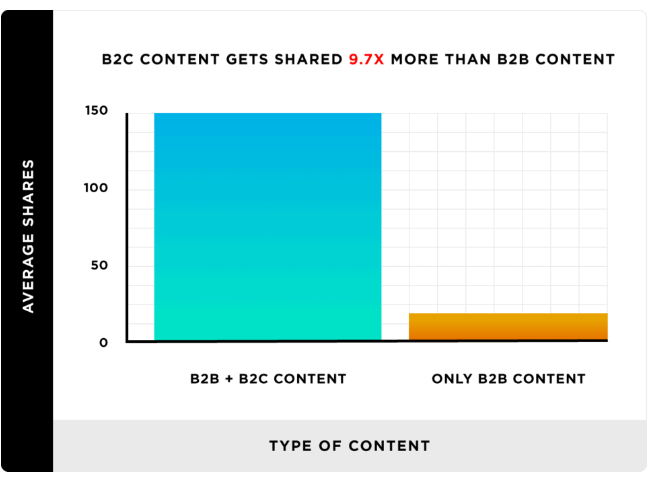
The average B2C blog post gets 9.7X more shares than a post published on a B2B site. (Backlinko)84% of B2B marketers say integrating or correlating content performance data across multiple platforms is moderately or very challenging. (CMI)

93% of B2B content gets zero links from other websites. (Backlinko)

Read on our blog: The 6 Fundamentals of an SEO Link Building Strategy

48% of B2B marketers say “not enough content repurposing” is their biggest barrier to scaling content production, ahead of all others. (CMI)

Successes and opportunities

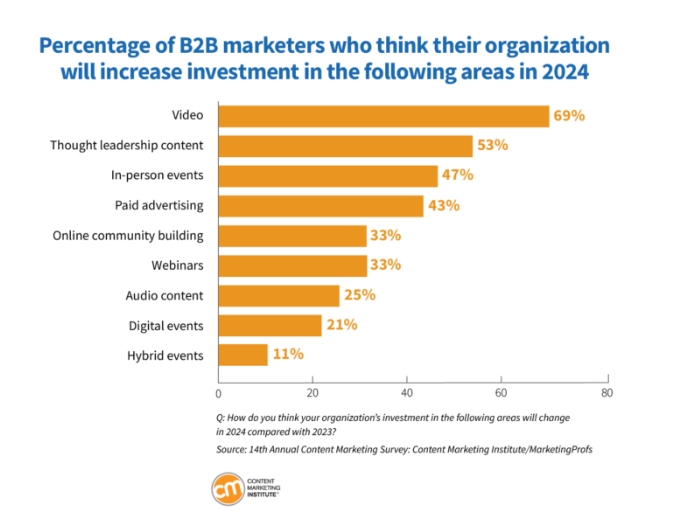
45% of B2B marketers said they expected their content marketing budget to increase in 2024. Video, thought leadership content and in-person events are the top areas of investment. (CMI)

Nearly 9 in 10 CMOs say they are advocating for bolder, more creative campaigns, with 67% increasing budgets for brand-building efforts. (LinkedIn)

61% of B2B marketers say better creative leads to more brand engagement, with 55% saying it helps them achieve greater share of voice. (LinkedIn)

“The two above are my current favorite content marketing stats. B2B execs are finally seeing the value in creative content and in top-of-funnel brand building. This is part of a broad shift towards looking at the buying cycle holistically instead of focusing on conversions. Earning people’s attention and getting that mental real estate is a huge part of marketing success now. It’s great seeing that what’s fun to make – cool, creative, empathetic, human – is also the best from a strategic standpoint.” – Joshua Nite, Senior Content Marketing Manager, TopRank Marketing

84% of B2B marketers say content marketing helps them create brand awareness. 76% say it helps them generate leads. (CMI)

Top-performing B2B marketers cite “knowing our audience” as the No. 1 factor in their content marketing success. (CMI)

Read on our blog: How B2B Brands Can Elevate Their Marketing by Aligning with Audience Passions 

Techniques, tactics and strategies

The most commonly used content types for B2B marketers are short articles/posts (94%), video (84%) and case studies (78%). (CMI)

Short-form content, such as infographics and blog posts, is also named by B2B buyers as the content type they find most appealing. (Demand Gen Report)

“There’s a big push in content marketing to create long-form content, even if you don’t necessarily have a great deal of new data and research to share. While there is always a place for longer blogs, B2B marketers should consider when they can make their content shorter and more visual. This will make it easier for their audience to quickly parse and share, and could even increase your odds of acquiring links.” – Harry Mackin, Content Strategist, TopRank Marketing

The content types B2B buyers say they rely on most at each stage of their journey are webinars (early), case studies (middle), and demos (late). (Demand Gen Report)

Read on our blog: Keys to Creating Case Studies That Get Results

89% of B2B marketers said they expected webinars to be effective for brand awareness and lead generation in 2024. (Sagefrog)

90% of B2B marketers say they use organic social media to distribute content. (CMI)

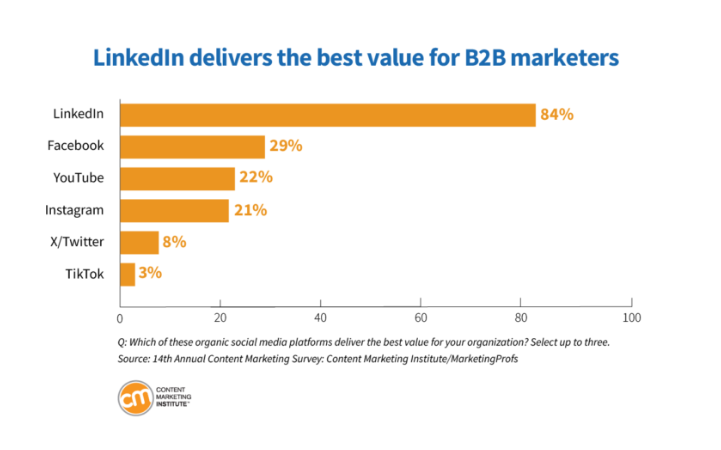
84% of B2B marketers say LinkedIn is the social media platform that delivers the best value. (CMI)

Only 10% of B2B marketers say their usage of X/Twitter or TikTok increased in the past year. (CMI)

55% of B2B marketers currently using Connected TV as a marketing channel said they plan to increase their future use. Connected TV is the second-fastest growing channel after social media. (LinkedIn)

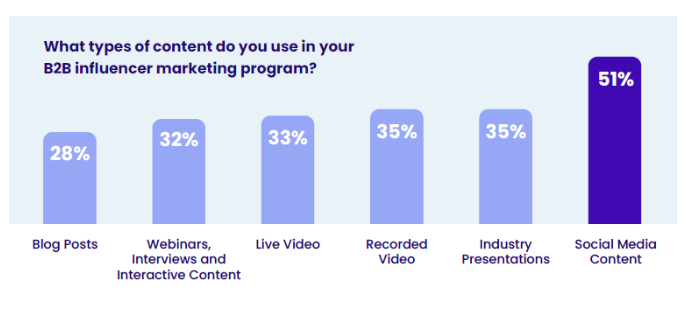
51% of B2B marketers say they create social media content as part of their influencer programs, making it the most popular type of influencer content. (TopRank)

30% of B2B marketers say they have the right content marketing management technology, but aren’t using it properly. (CMI)

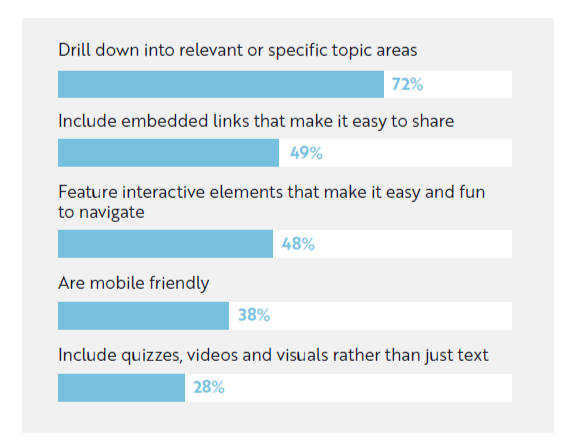
72% of B2B buyers say they are most likely to engage with content that drills down into relevant or specific topical areas. (Demand Gen Report)

B2B content marketing and AI

Nearly three-quarters of B2B marketers (72%) say they use generative AI, but 61% say their organization lacks guidelines for its use. (CMI)

Only 1 in 4 B2B marketers say they have an extremely good understanding of how to use AI in marketing activities. (LinkedIn)

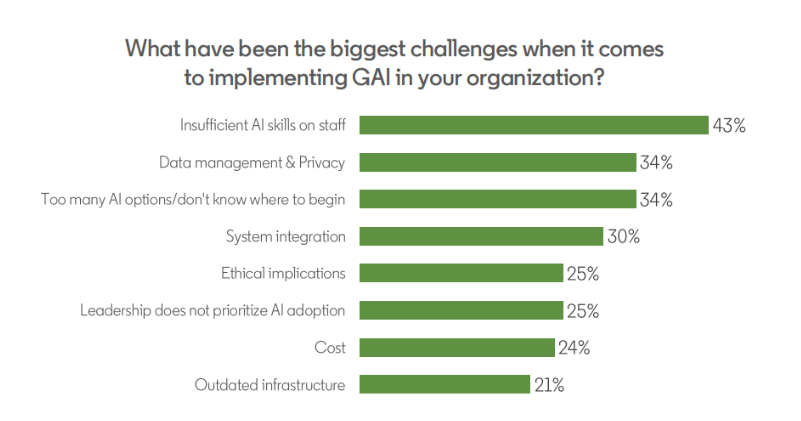
43% of B2B marketers cite insufficient AI skills as a barrier to implementing GAI in their organization. (LinkedIn)

The most popular use for generative AI in content is to brainstorm new topics (51%), followed by researching headlines/keywords (45%) and writing drafts (45%). (CMI)

Content creation is the most common way B2B marketers are using AI for influencer marketing. (TopRank)

58% of B2B marketers say they are optimistic about the outlook for AI in B2B marketing. (Sagefrog)

Ready to take the next step with your B2B content marketing? Learn how smart strategies drive brand growth, or reach out to learn how we can help you.


The post Set Your Strategy with These 28 B2B Content Marketing Stats appeared first on TopRank® Marketing.
Read More »

Total Pageviews